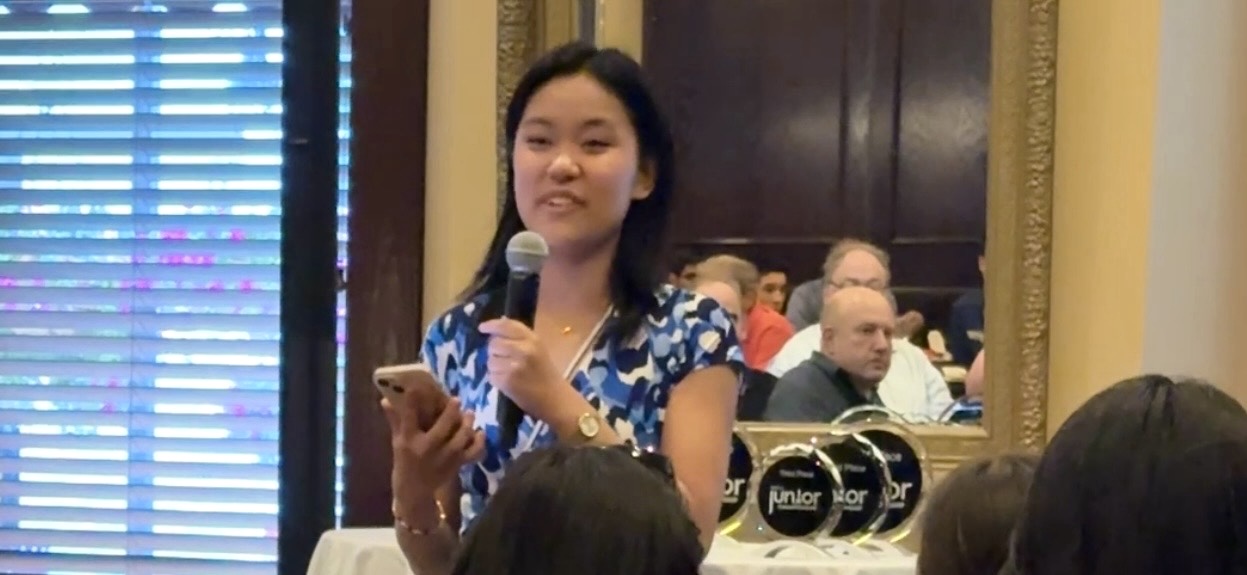

Imagine this: you’ve traveled to St. Louis to play in one of the most prestigious youth events in the US, for your fourth year this time. The nine other girls in your section are among the top young female players, and you’re all fighting for the $15,000 first prize. Imagine that you’re the top seed, the one statistically most likely to win it all; the one who all the cameras initially point at.
Now imagine you draw your first three rounds. Unfortunately, this was me at this year’s US Junior Girls Championship.
Certainly, scoring 1.5/3 against the nation’s most talented girls is not bad. Yet in a field where the most recent winning scores have been 7/9, 7.5/9, and 7/9, losing 1.5 points early on leaves little wiggle room. And it depends on the quality of those draws, too—if, like me, your rounds 1 and 3 were draws from losing positions, while round 2 was a draw from a winning position, doubt might creep in. If you can’t get good positions against lower-rated players, and if you can’t even convert when you finally do get a good position, isn’t that indicative of some fundamental problem?
I managed to win the next four games in a row, (finally) catapulting myself into the shared lead with FM Megan Paragua, who at 12 years old is one of the biggest current American talents. As luck would have it, we were to face each other in round 7, the very next round.
The important thing about prodigies is to beat them when they’re young, though I might have been a year too late: I was slightly worse out of the opening, which eventually carried into the endgame. The engine said it was equal, but both of us knew only Megan could win.
Slowly, I realized my position was fine. I’d managed to get a passed d-pawn, and that omnipresent pressure was gone. With a minute on the clock, I had one more choice to make—I could trade her knight and enter an easily-drawn position, or I could play on and risk overlooking counterplay. With the draw I’d worked so hard for suddenly in reach, I didn’t hesitate long before taking it.
Imagine my disappointment when I discovered my position was -5 back at the hotel room. -5 is equivalent to being up a full piece for absolutely no compensation. Why hadn’t I played on??? A win would have likely guaranteed first place for me, in sole lead with only two rounds to go. Now I was tied with Megan and WFM Rachael Li.
I won my next game, while Megan and Rachael both drew. All I had to do was win one more game. And though everyone expected the endgame I got to be a draw, I eventually managed to squeeze out a win in the final round. It was enough for the tournament victory!!! I was (still am!) super happy. Winning this amazing tournament has always been one of my dreams. Already this year my WGM title has been confirmed; now I’ve won my favorite tournament growing up. There’s still so much to achieve, and I know I’m capable of doing it all.
*********
Although false, everyone knows goldfish have very short memories (three seconds, by some accounts). As chess players, losing and/or disappointments are inevitable, and they hurt, some more than others. Ideally we channel this frustration into learning, but during the moment it can feel overwhelming. So be a goldfish: forget about the previous rounds, and focus on what is happening in the moment. Analyze and improve after the tournament, but don’t let negative feelings override your skill. Take it from this goldfish champion 🙂